How to Build a Study Schedule That Survives Finals
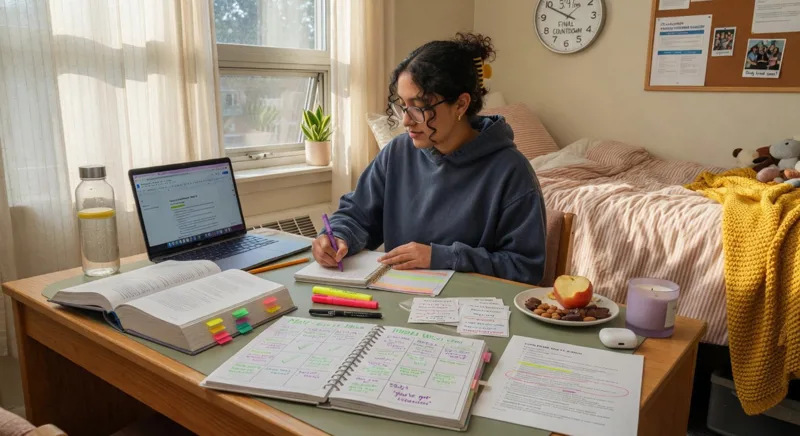
Finals rarely go exactly as planned. A strong study schedule leaves room for difficult topics, unexpected assignments, low-energy days, and proper sleep. Here’s how to build a realistic finals study plan that keeps you progressing without relying on last-minute cramming.
Start With a Complete Finals Overview
Before opening a textbook, gather every important deadline in one place. Write down each exam date, start time, location, format, and the material covered. Include major papers, presentations, labs, and projects too.
Next, rate each subject according to three factors:
- Urgency: How soon is the exam?
- Difficulty: How challenging is the material for you?
- Importance: How much does the exam affect your final grade?
This prevents a common mistake: spending most of your time on the class you enjoy while neglecting the subject that needs the most attention.
Break Each Course Into Manageable Study Tasks
“Study chemistry” is too broad to guide your next action. Instead, divide each course into specific topics and skills. For example, a biology study plan might include cell signaling, genetics, anatomy diagrams, and practice questions.
Turn each topic into a task with a visible outcome:
- Review lecture notes on cellular respiration.
- Create a one-page formula sheet.
- Complete 20 practice problems.
- Explain the main theory without looking at your notes.
- Take a timed practice exam and review mistakes.
Specific tasks make your study schedule easier to follow and help you measure real progress rather than simply counting hours.
Use Spaced Practice Instead of Cramming
The most resilient finals study schedule distributes learning across several shorter sessions. Studying one hour a day for three days usually creates more opportunities to recall information than studying for three hours in one sitting.[1]
Try to revisit important material at least three times:
- Learn the concept and create a brief summary.
- Review it one or two days later using practice questions.
- Test yourself again several days later without relying on notes.
This approach uses spaced repetition and retrieval practice. Instead of rereading until the material feels familiar, close the book and ask, “What can I remember?” Flashcards, blank-page recall, practice tests, and teaching the concept aloud are all useful methods.
Build Your Weekly Study Schedule
Start with fixed commitments such as classes, work, meals, commuting, exercise, and sleep. Then schedule study blocks around them. Avoid filling every available minute; a plan with no breathing room is unlikely to survive finals week.
A practical study block might look like this:
- 45 minutes of focused work
- 10–15 minute break
- 45 minutes of focused work
- Longer break for food, movement, or rest
You can also use the Pomodoro technique: 25 minutes of study followed by a five-minute break. The best study interval is the one you can repeat consistently. Breaks help your brain recover and make it easier to sustain several focused sessions.[1][4]
Plan by Priority, Not Just by Subject
Give the most time to material that is difficult, heavily weighted, or likely to appear on the exam. A simple weekly allocation could look like this:
| Course need | Study emphasis | Best activity |
|---|---|---|
| High difficulty | Frequent shorter sessions | Practice problems and tutoring |
| Moderate difficulty | Regular review | Retrieval practice and summaries |
| Low difficulty | Maintenance sessions | Flashcards and practice quizzes |
Make Every Study Block Specific
At the beginning of each session, define what “done” means. For example, “finish Chapter 6” is vague, while “complete 15 Chapter 6 problems and correct every mistake” is measurable.
Use a simple three-part structure:
- Warm up: Recall what you studied previously.
- Learn or practice: Work on the day’s main objective.
- Check: Complete a short quiz or write down what remains unclear.
Keep an error log for missed questions. Reviewing mistakes is often more valuable than repeatedly practicing material you already know.
Protect Sleep and Recovery
Sleep belongs on your finals study schedule, not at the bottom of your priorities. Research consistently connects better sleep quality with stronger academic performance, while sleep loss can interfere with memory encoding and retention.[2][3]
Set a realistic bedtime, especially during the final week. A late-night study session may add hours to your schedule, but fatigue can reduce concentration and recall the next day. Schedule meals, movement, short breaks, and at least one lighter period each day.
Leave Buffer Time for Real Life
Reserve roughly 10–20% of your planned study time as flexible space. Use it for difficult chapters, unexpected assignments, illness, or catching up after an unproductive day.
At the end of each day, spend five minutes adjusting tomorrow’s plan. Move unfinished tasks forward, but do not automatically double the workload. Shrink the task, change the method, or ask for help from a professor, tutor, or study group.
Use a Finals Week Strategy
During finals week, shift from broad learning to targeted review. Focus on practice exams, weak areas, key formulas, definitions, and common question types. Avoid trying to relearn an entire course the night before.
For each exam, prepare a short final-review checklist:
- Topics you can explain confidently
- Topics requiring one more practice session
- Questions or formulas you frequently miss
- Exam materials, location, and start time
A study schedule that survives finals is not rigid or perfect. It is specific enough to guide you, flexible enough to absorb setbacks, and balanced enough to protect your energy. Plan early, study with active recall, space out your reviews, and treat sleep as part of preparation. That combination turns a stressful finals week into a series of manageable next steps.
References
You May Also Like
 Careers
What No One Explains About the First Year of Work
 Careers
Understanding Employee Benefits for the First Time
 Real Estate
Your First Apartment Checklist After Graduation